Law School Admissions
Don’t Pay for Law School

Nathan Fox
Jul 8, 2021Updated August 24, 2026
Ben Olson asked:
“Hey,
Do we have a lesson on the scholarship estimator?
Potential applicants should be using it more.
Can you go to a decent school for free? If not, keep studying or quit.”
Doesn’t mince words, does he?
“Can You Go to a Decent School for Free? If Not, Keep Studying or Quit.”
Here at LSAT Demon, it is our firm belief that you should go to the best law school for the best price, and oftentimes, that means going for free. That’s because law school tuition is wildly inflated, J.D. job outcomes are far from certain, salaries are bimodally distributed, and most law schools—including schools in the T-14, the T-100, and outside the T-100—give lavish full-tuition or greater-than-full-tuition scholarships to students smart enough to take them.
You don’t even have to be particularly overqualified to get a scholarship. You just have to decide you want one. No matter who you are, no matter where you live, no matter what type of law you want to practice—don’t pay for law school.
Either You’re Getting One of These Scholarships or You’re Paying for Them.
If you don’t believe me, please follow Ben’s advice and check out our LSAT Demon Scholarship Estimator. I’ll run through a few examples, but there’s no substitute for plugging in your own numbers and finding your own target schools.
Can I still get a scholarship if I’m a good, but not great, candidate?
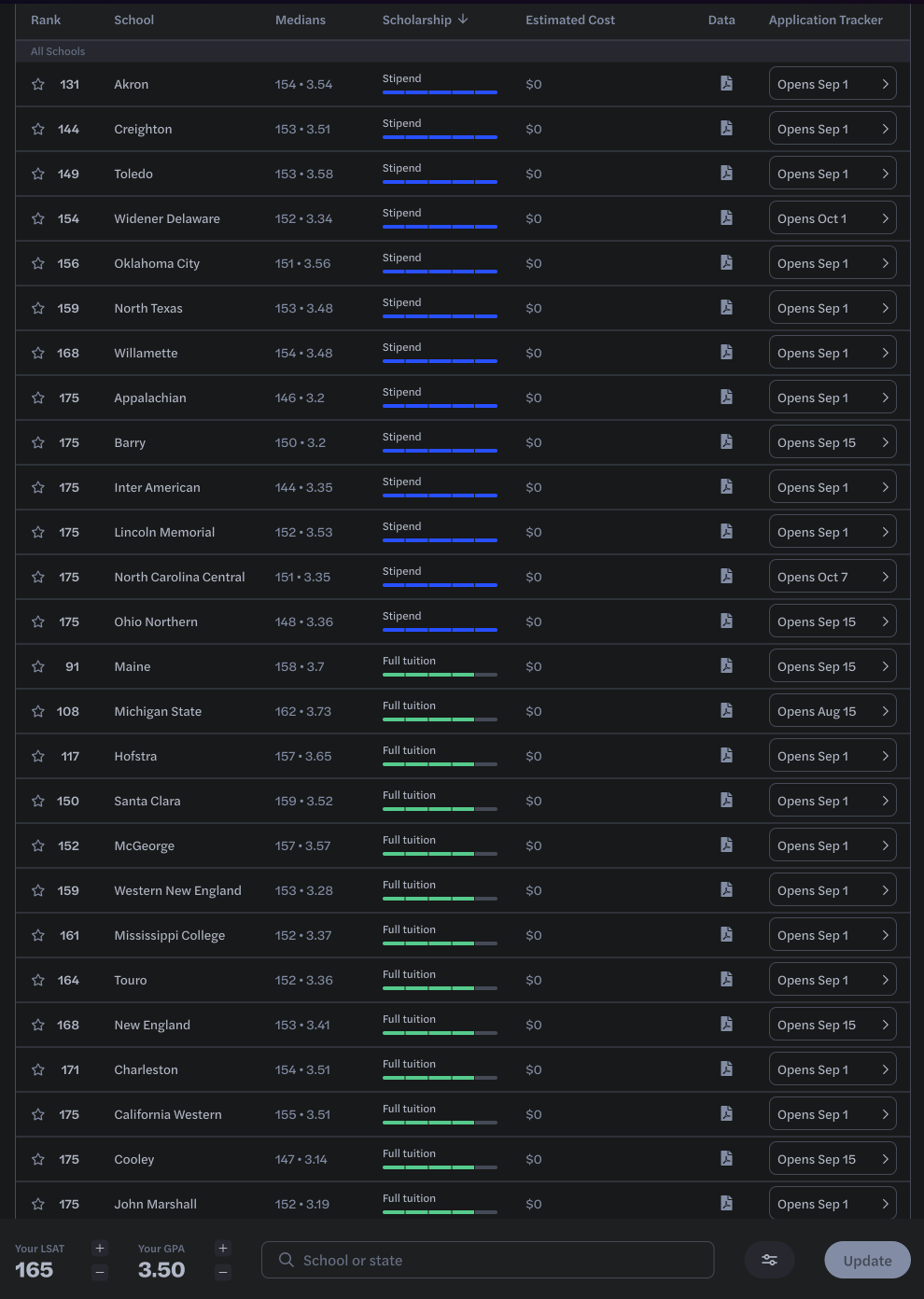
You bet your ass you can. Applicants with 3.5 GPAs and 165 LSATs are a dime a dozen—but law schools across the country throw money at them nonetheless. Click the scholarship column to sort the results from best to worst, then start scrolling to see all the offers you could receive.
Can a Great LSAT Score Make Up for a Low GPA?
A school within the top 30 probably isn’t going to offer a full ride to this good-but-not-great candidate. But before we exit the top 100, we start seeing green. Green means a full ride—free law school. And we even start seeing blue—that’s when schools start paying you.
That’s right—not only can this fairly ordinary applicant go to law school for free, but they can actually get paid to go. And it’s not just one or two fluke schools, either. Sort by total cost of attendance, and you see this:
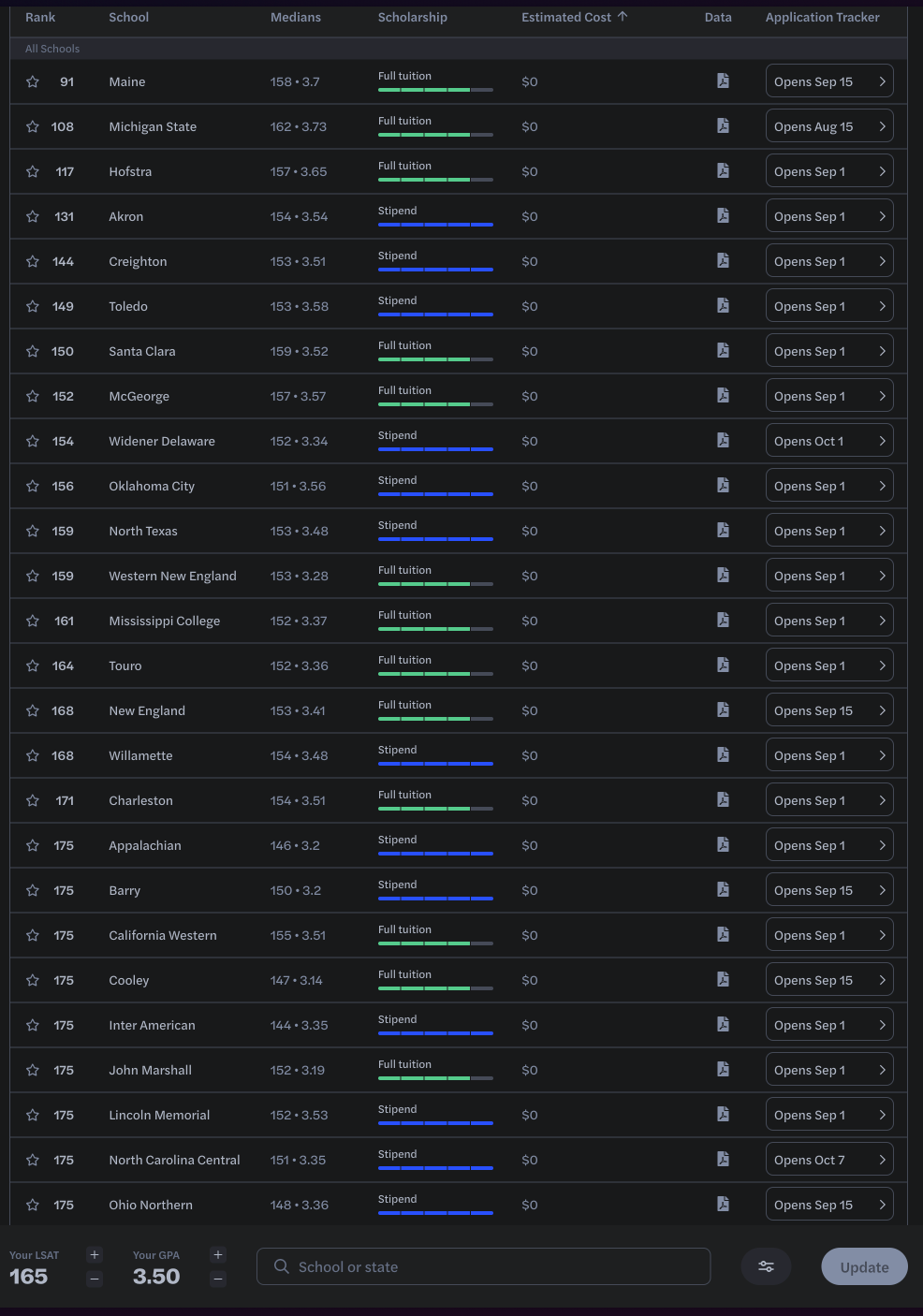
There are dozens of law schools all across the country—falling all over themselves to give this moderately good applicant full tuition, plus a stipend, to attend.
But what if I have bad grades?
A good LSAT can cover a lot of undergraduate sins. Let’s imagine a bad undergraduate GPA like mine—2.54—along with an excellent LSAT of 175. Can this splitter go to law school on a great scholarship or even for free?
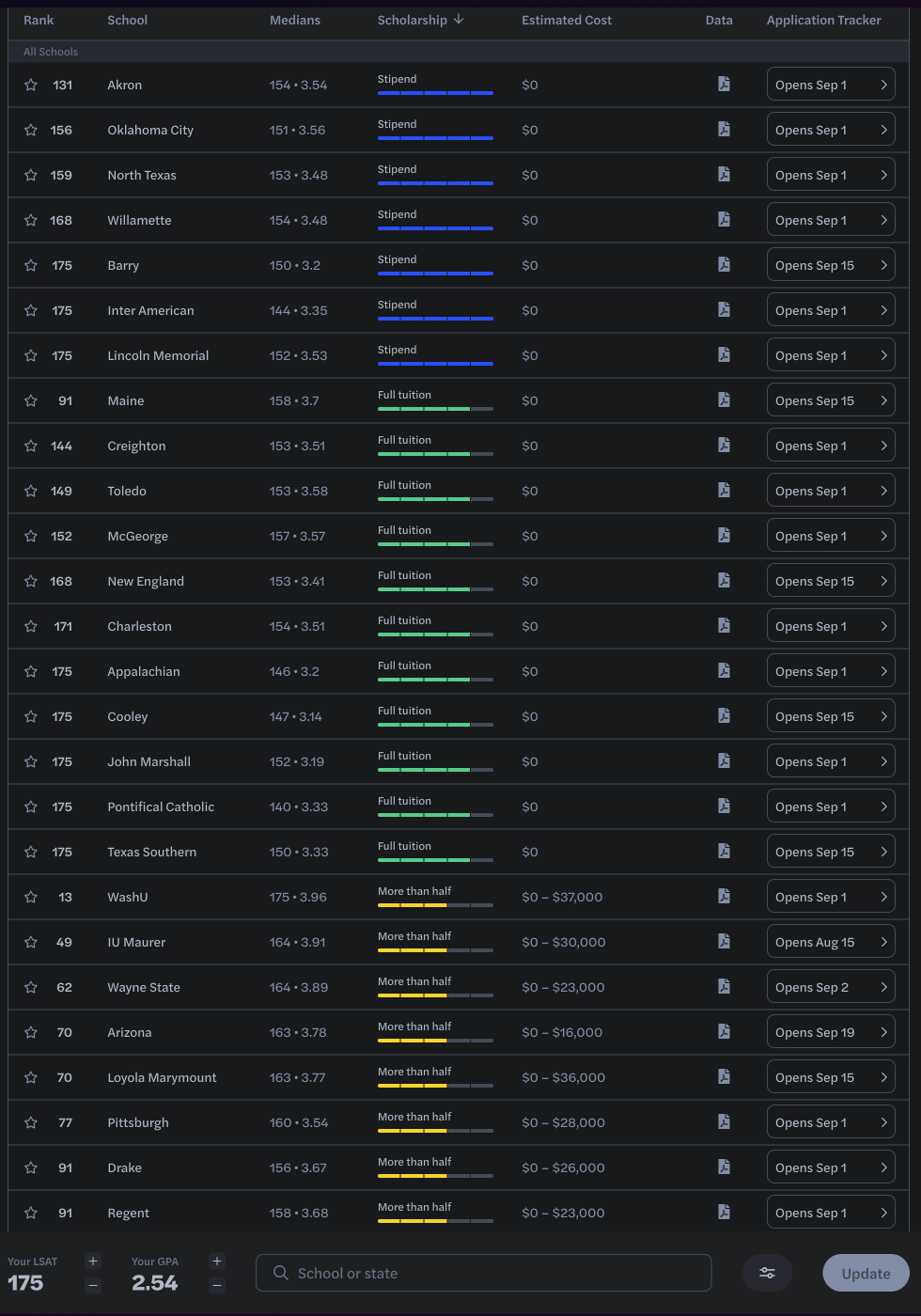
Yup.
But what if I have a low LSAT?
Let’s try a good undergraduate student—3.75 GPA—with a bad LSAT of 155. Can this student go for free?
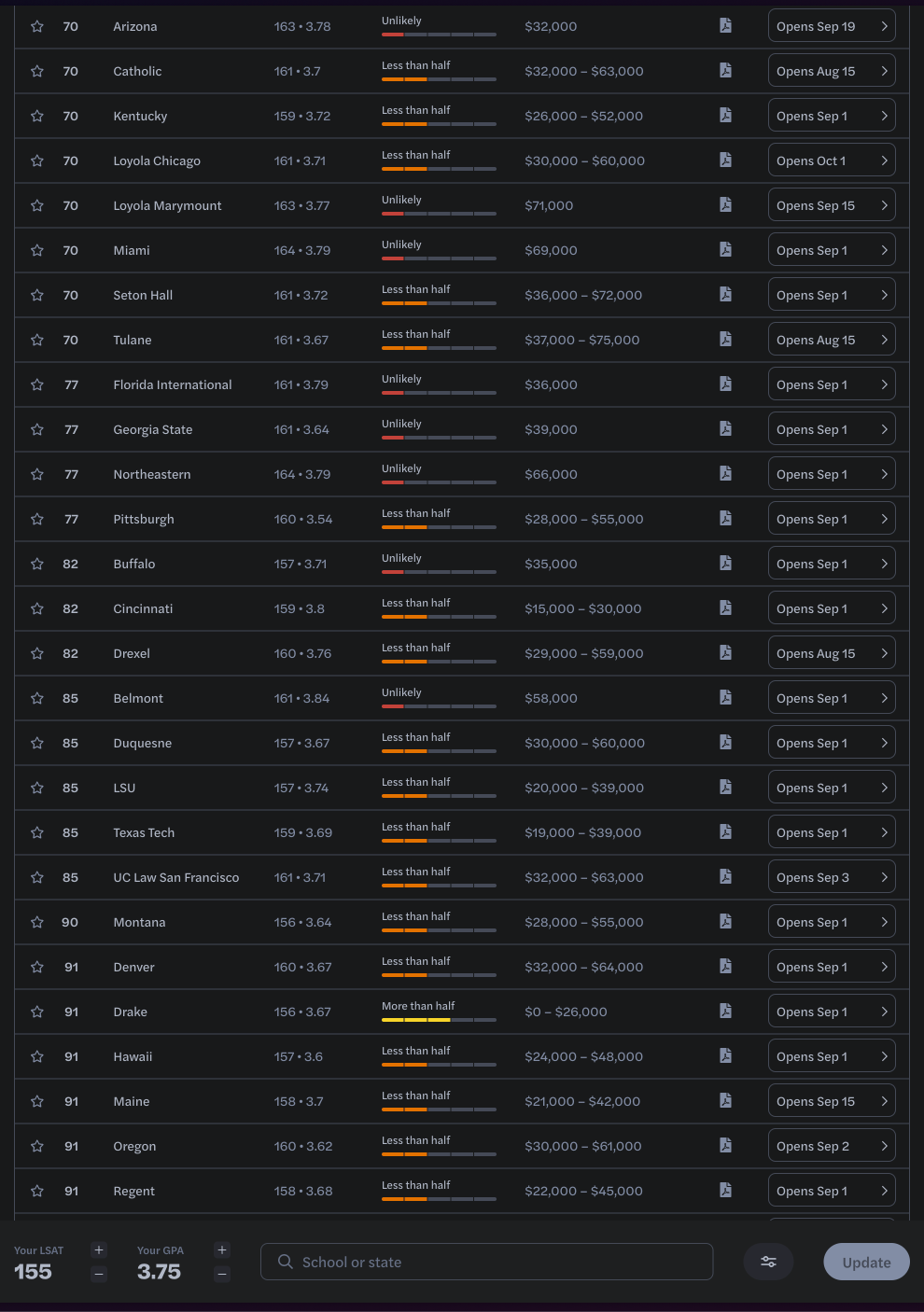
Yes, but their options are more limited. This applicant really needs to improve their LSAT score. Your LSAT is the one thing in your application that you can really change. How do the scholarship estimates change with a typical 10-point improvement? They get dramatically better:
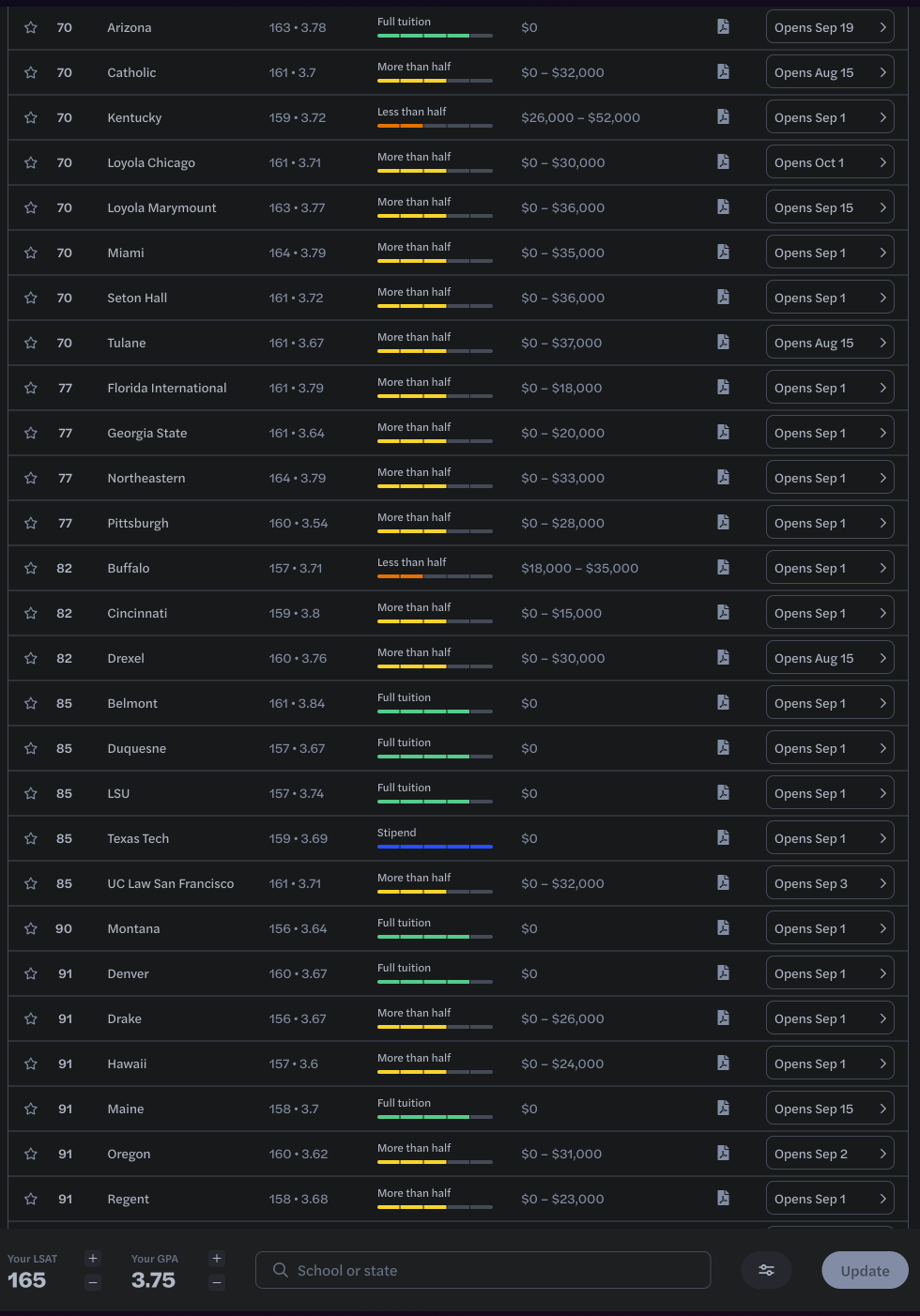
Why 10 LSAT Points Could Be Worth $100K
A 10-point improvement on the LSAT would expand this high-GPA/low-LSAT student’s prospects significantly: a full-ride-plus-stipend offer, more full-ride offers, and offers from much better schools. It’s not a stretch to say that 10 LSAT points are worth $100,000 or more in free tuition. Keep going! Retake the LSAT! Get every single point you can. Each point is worth about 10 grand in scholarships.
But what if I have bad grades and a low LSAT?
Improve your LSAT, or just don’t go to law school. The scholarship estimates for a 2.5-GPA/150-LSAT applicant are grim:
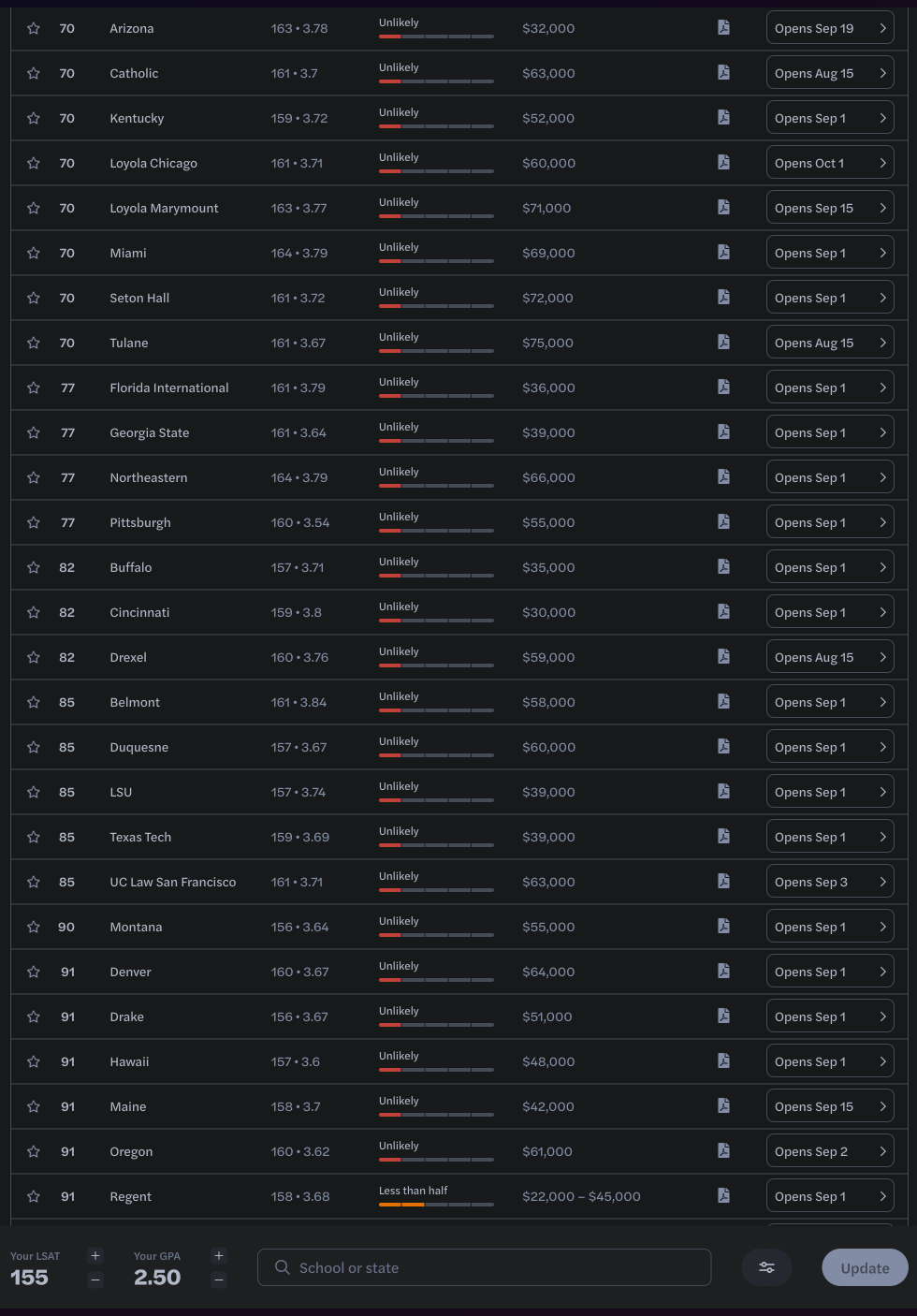
The money for those scholarships we were salivating over has to come from somewhere. At every school, everywhere along the spectrum, there are applicants lining up to pay for law school. Don’t be one of them. Get good grades in your remaining classes if you’re still an undergrad—grades absolutely do matter. Your GPA gets you one step closer to going to law school for free.
But whether or not you can change your GPA, you need to get the best LSAT score you possibly can. Schools all across the country back up the Brinks truck and shower cash on high-LSAT applicants every cycle. And yes, this does happen at the very top of the pyramid as well.
Use our sample questions to start practicing for the LSAT and improve your chances!
What if I’m a baller?
Let’s see the options for an elite applicant—one with a 3.95 GPA and a 175 LSAT:
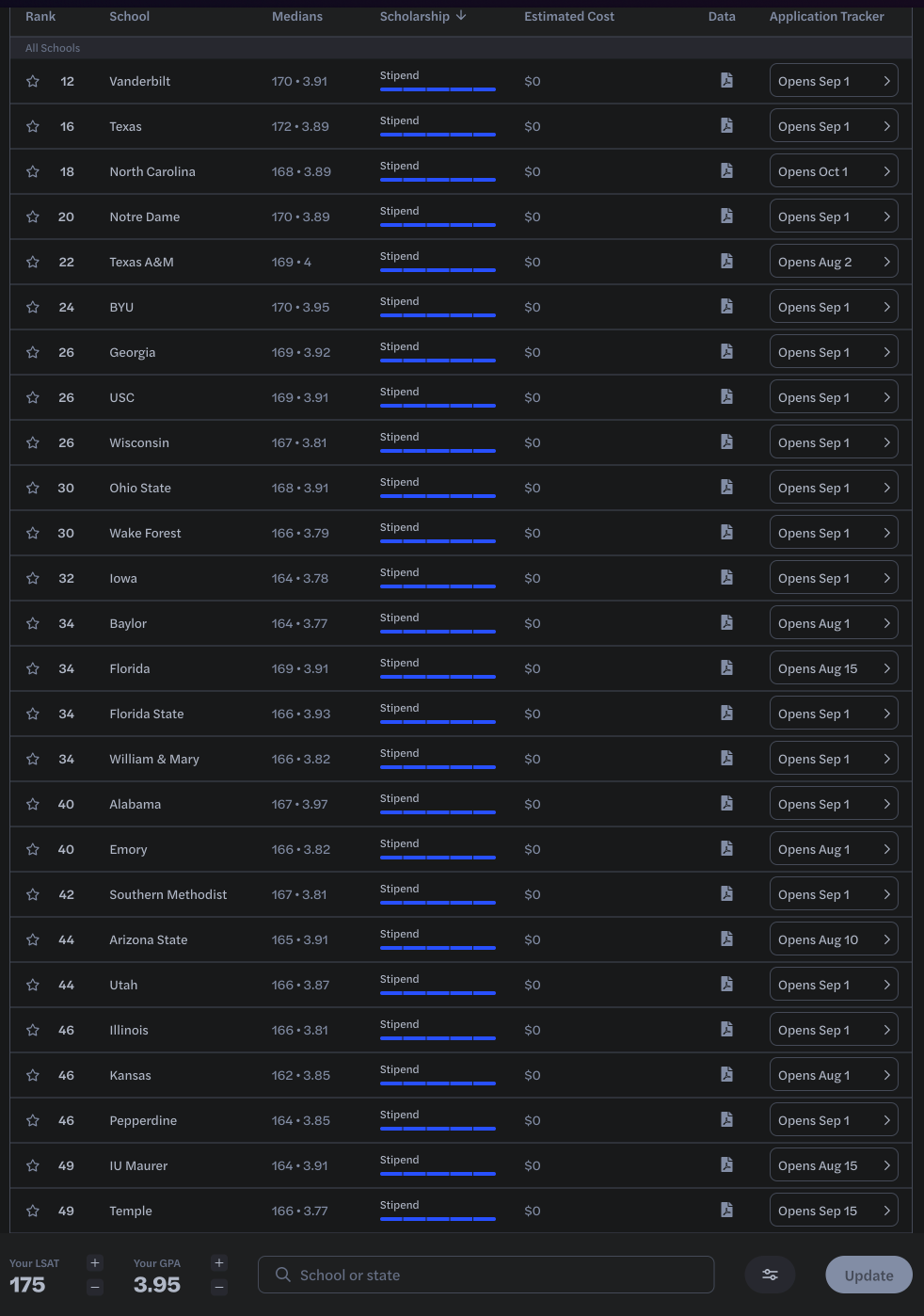
Now we’re talking. A 3.95/175 applicant has a chance of getting into Yale, Stanford, and Harvard. The rest of the lower T-14 and T-20 know this, so they use money to entice these students away from the elite-of-the-elite law schools. This student gets their pick of a ton of amazing options. Should they pay for Harvard? Or take a full ride to Vanderbilt? It’s a good problem to have. Ben and I, of course, would always default to “don’t pay for law school.” Take the money. You’ll do just fine.
Your results will vary, of course. The estimator is just an estimator. But we’ve sent thousands of students to law schools across the country. These students had widely varying GPAs and LSATs, and they’ve racked up millions of dollars in scholarships. Try the LSAT Demon Scholarship Estimator and see for yourself.